

Short summary
- High-performance Class AB stereo power amplifier
- 800W custom toroidal linear power supply
- Three pairs of precision MOSFET output devices
- Ultra-low 0.003% harmonic distortion
- Up to 500W into 8Ω in bridged mode
- Designed for demanding full-range loudspeaker systems
Specifications
| Weight | 15.9 kg |
| Dimensions (HxWxD) | 119 × 265 × 388 mm |
| Shipping Weight | 18.6 kg |
| Enclosure type | Stereo Power Amplifier |
| Enclosure material | CNC-Machined Aluminium |
| Power output | 180 W (8 Ω) / 280 W (4 Ω) |
| Amplifier Classs | Class AB |
| THD+N | 0.003% @ 1kHz |
| Frequency response | 10Hz–30kHz (±0.5dB, @ 1W/8Ω) |
| S/N Ratio | ≥115dB (A-weighted) |
| Crosstalk | ≤−95dB (180W @ 8Ω / 1kHz) |
| Input sensitivity | XLR: 5.2V / 2.6V; RCA: 2.65V / 1.3V |
| Input impedance | XLR: 10kΩ / RCA: 10kΩ |
| Output Impedance | 1200W |
| Gain | 23dB / 29dB Selectable |
| Input voltage | 100–120V AC 60Hz / 220–240V AC 50Hz |
| Control system | 12V Trigger In / Out |
| Crosstalk | ≤−95dB (180W @ 8Ω / 1kHz) |
| Watts per channel | 180W RMS @ 8Ω / 280W RMS @ 4Ω |
| Number of channels | 2 (Stereo) / 1 (Bridged Mono) |
| Display | Dual Analog VU Meters |
| Power Supply | 800W Custom Toroidal Linear Power Supply |
| Damping Factor | >400 (@ 8Ω, 1kHz) |
| Binding Posts | Premium Speaker Output Terminals |
| Display | Dual Analog VU Meters |
| Inputs | Balanced XLR, Unbalanced RCA, 12V Trigger Input |
| Outputs | Speaker Outputs, 12V Trigger Output |
| Analog inputs | 1x RCA (Stereo), 1x XLR (Stereo) |
| Analog outputs | Speaker Outputs |
| Connections | XLR, RCA, Speaker Terminals, 12V Trigger In/Out |
| Analog Audio Output | Speaker Outputs |
| Media Connection Options | Balanced XLR, Unbalanced RCA, 12V Trigger |
| Control Systems | 12V Trigger In/Out |
| Control Methods | Front Panel Controls, 12V Trigger |
| What's in the box | Eversolo AMP-F8 ×1, Power Cable ×1, Trigger Cable ×1, User Manual ×1 |
Description
AMP-F8 and AMP-F10 at a glance.
Eversolo’s Class AB stereo power amplifiers, side by side. Here is the AMP-F8 with the larger AMP-F10 above it, showing what your money buys at each step.
|
AMP F8
This model
|
AMP F10
|
|
|---|---|---|
| Price | £1,700.00 | £2,199.00 |
| Power Output | 180 W (8 Ω) / 280 W (4 Ω) | 200W (8 Ω) / 320W (4 Ω) |
| Analog inputs | 1x RCA (Stereo), 1x XLR (Stereo) | 1x RCA (Stereo), 1x XLR (Stereo) |
| Analogue Outputs | Class AB | Class AB |
| Dimensions (HxWxD) | 119 × 265 × 388 mm | 430 x 147 x 310 mm |
| Weight | 15.9 kg | 18 kg |
The long read.
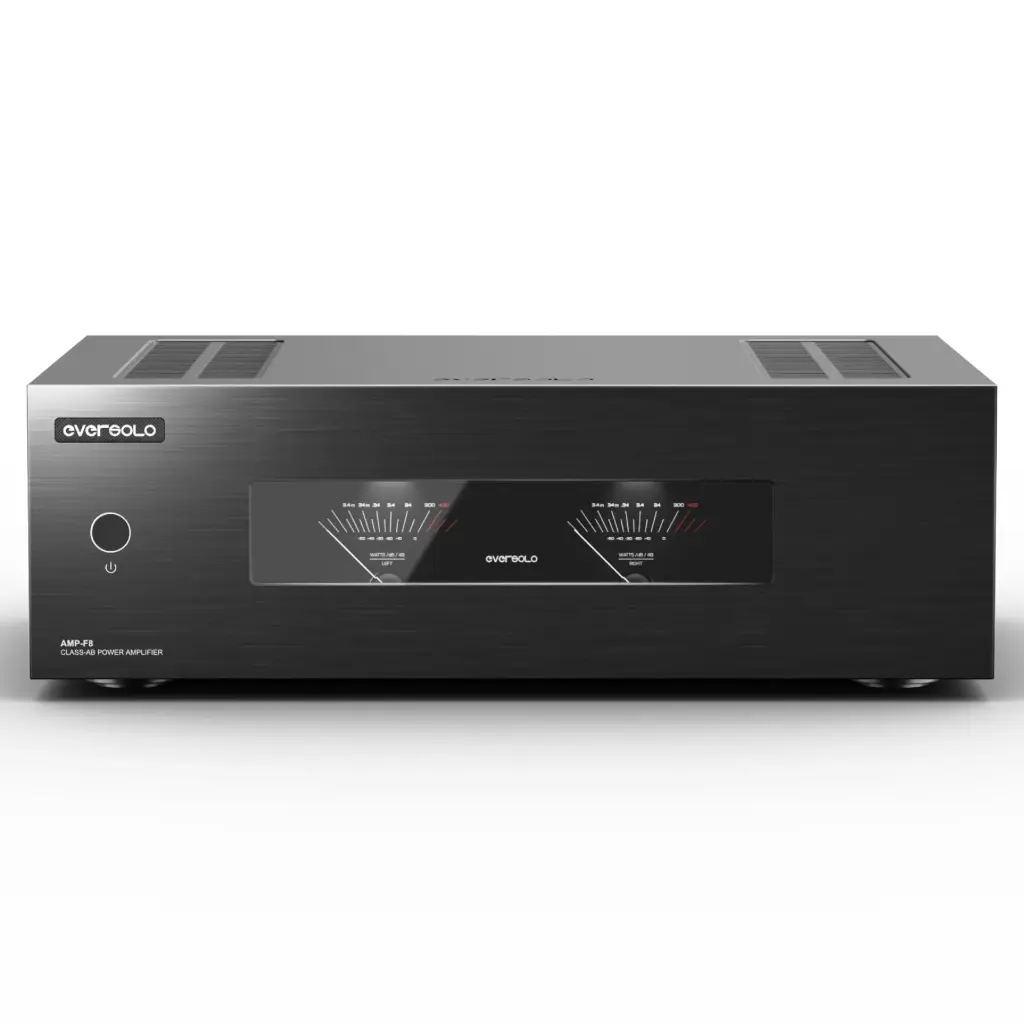
The AMP-F8 is Eversolo’s half-width Class AB power amplifier, and the more affordable way into the company’s linear-supply amplification. It has no streaming, DAC or volume control. Its job is to take a line-level signal from a preamplifier, or from a streamer with variable output, and drive a pair of loudspeakers. It shares its width and depth with Eversolo’s DMP streamers, so it sits alongside them as a matched pair. Next to the AMP-F10 above it, it gives up some power, the dual-mono layout and some of the supply reserve, and keeps the same Class AB MOSFET approach, switchable gain and analogue meters for less.
Brief product overview
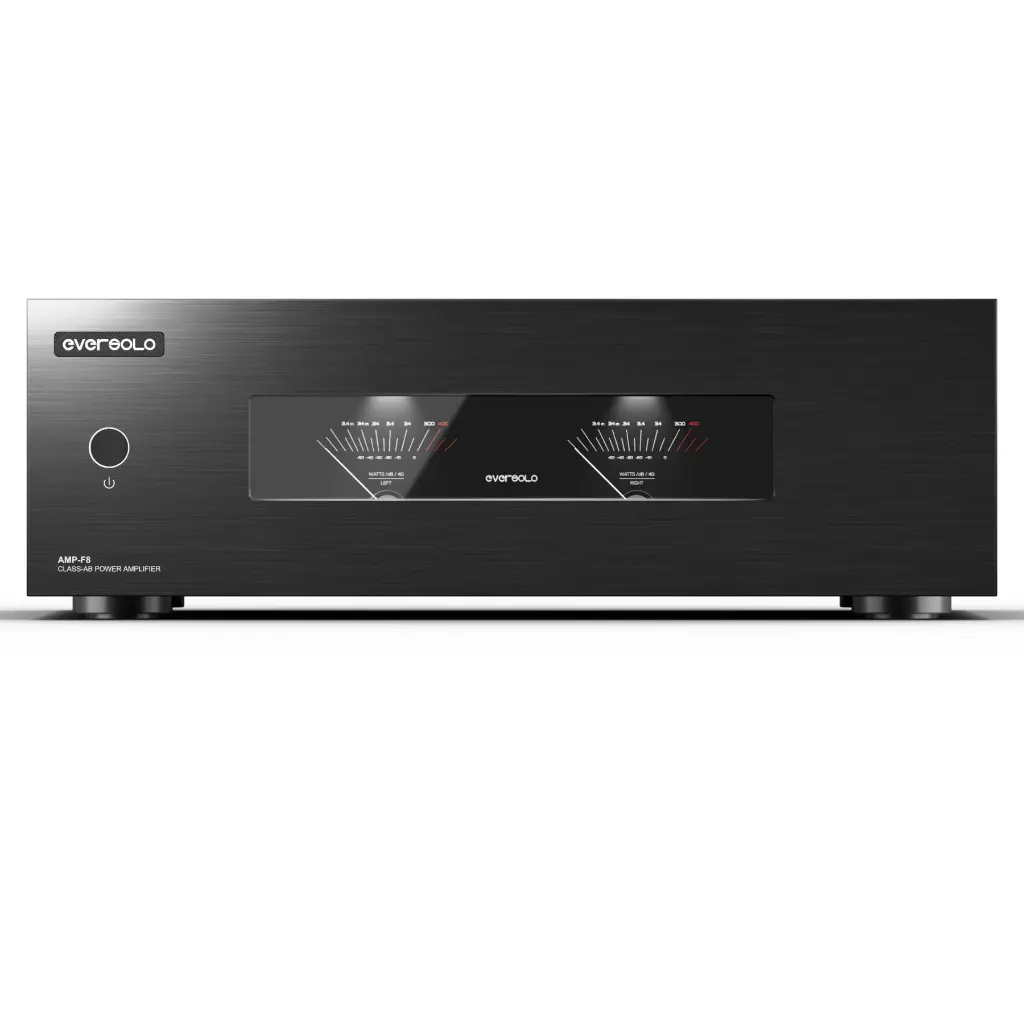
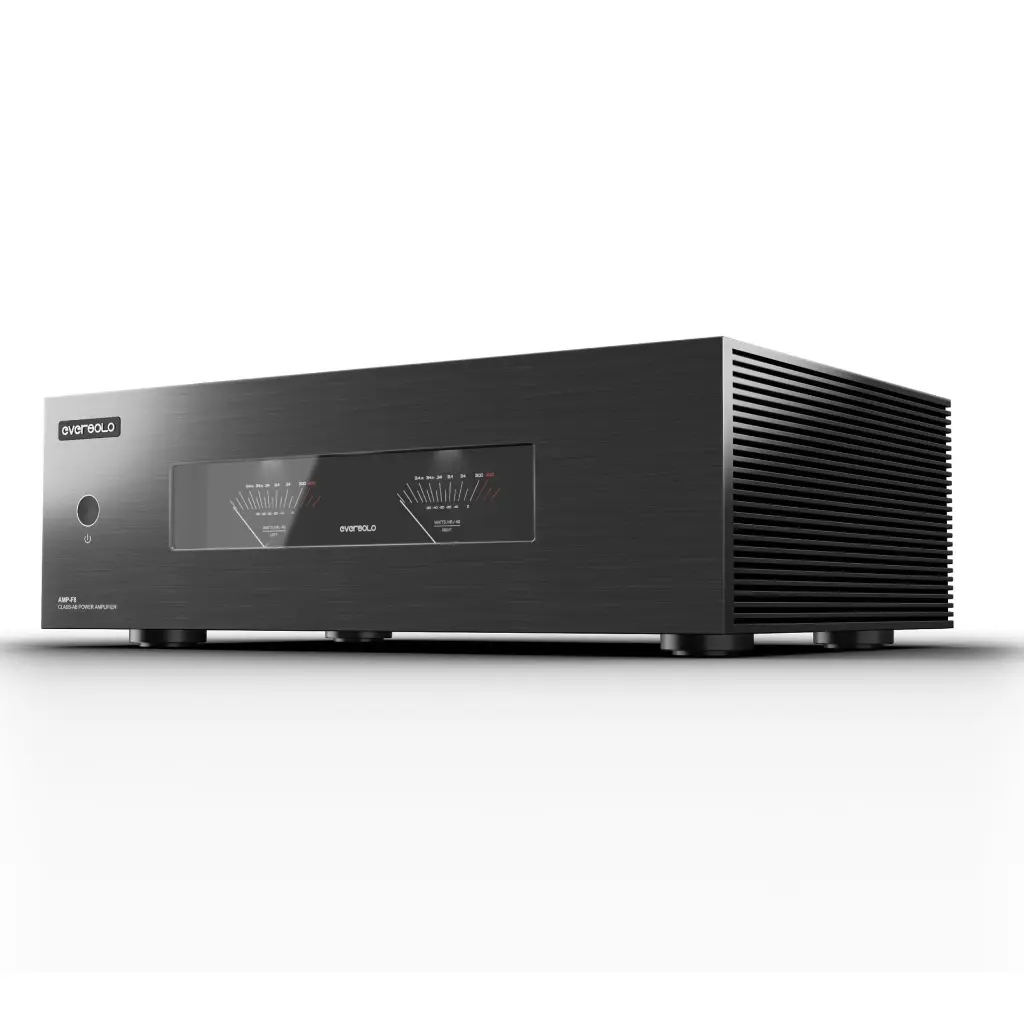
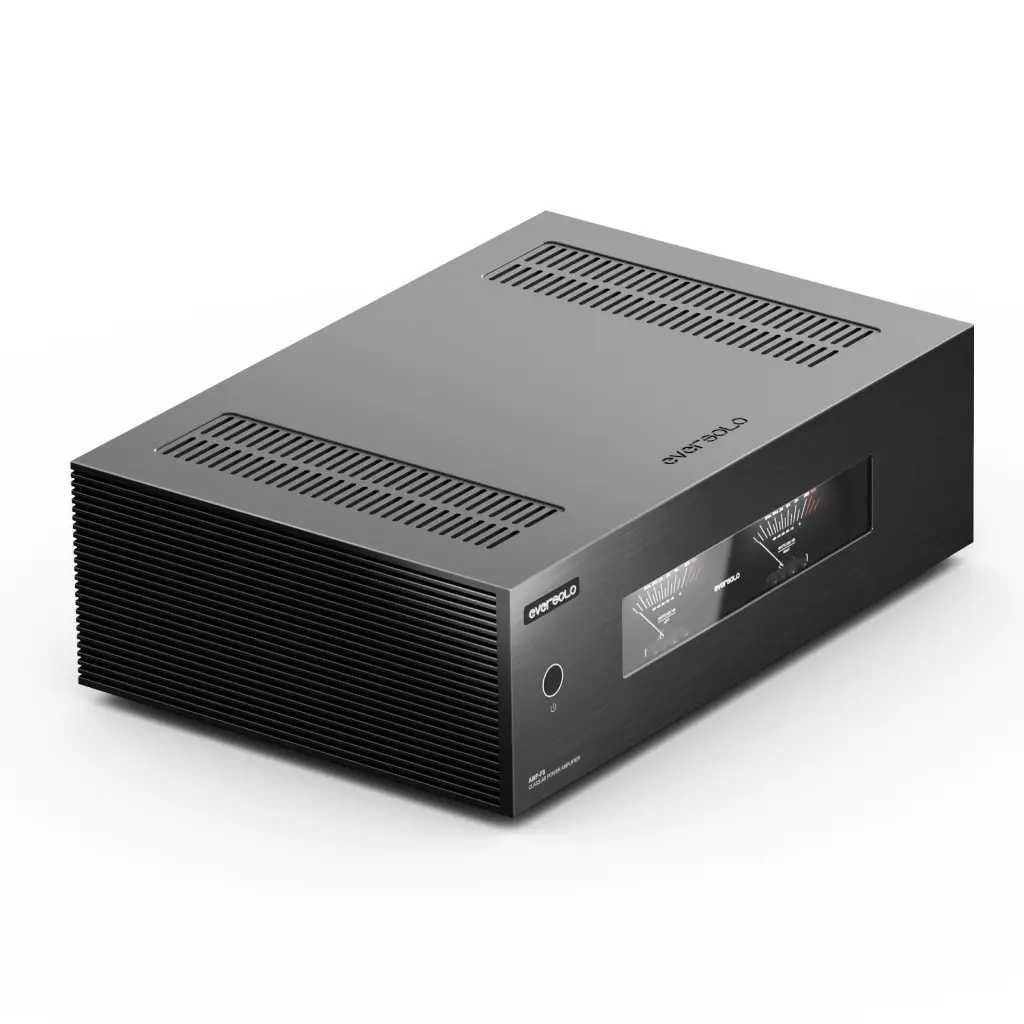
A Class AB stereo power amplifier built around three pairs of precision MOSFET output devices and an 800-watt custom toroidal linear power supply. It is rated at 180 watts per channel into 8 ohms and 280 watts into 4 ohms. Bridged as a mono amplifier, it delivers 500 watts into 8 ohms. Eversolo quotes distortion at 0.003% at 1kHz, a signal-to-noise ratio of at least 115dB (A-weighted), a damping factor above 400 and a frequency response of 10Hz to 30kHz within half a decibel. Gain is switchable between 23dB and 29dB, so the amplifier can be matched to the output level of the source driving it. Inputs are one pair of balanced XLR and one pair of single-ended RCA, and 12V trigger connections let the amplifier power on and off with its preamplifier. Dual analogue VU meters sit on the front of a CNC-machined aluminium case measuring 119 × 265 × 388mm and weighing 15.9kg.
How it sounds
The AMP-F8’s character follows from its design. A linear supply of this size gives the output stage reserves for dynamic peaks, so bass should stay held together as the level rises rather than softening. The MOSFET Class AB output stage and very low quoted distortion point to a clean, neutral amplifier that adds little of its own. The high damping factor gives firm control over the bass drivers of a floorstanding speaker. It is a new model, so we would rather describe what the engineering delivers than claim a signature it has not yet earned in the listening room. The honest limits: 180 watts into 8 ohms is generous for most speakers of average sensitivity, but large, low-sensitivity speakers in a big room will find the AMP-F10’s extra reserve worthwhile. And as a Class AB design it runs warm and draws more at idle than Eversolo’s compact Class D amplifiers.
What we’d partner it with
The Eversolo DMP-A8 Gen 2 is the natural front end. It is a network streamer, AKM DAC and fully balanced analogue preamplifier with a relay-switched R-2R volume control. It feeds the AMP-F8 over XLR, and it brings streaming, HDMI eARC for a television, room correction and analogue inputs for a phono stage. The DMP-A8 Master Gen 2 is the same platform with an oven-controlled crystal oscillator, a 10MHz external clock input and a built-in CD drive, for a system that plays discs as well as streams. The DMP-A6 Master Edition Gen 2 is the lower-cost front end (stock permitting). Any of them must be set to variable output, since the AMP-F8 has no volume control of its own.
For speakers, the Monitor Audio Silver 300 8G is a three-way floorstander with a 25mm C-CAM Gold Dome tweeter on a UD Waveguide II, a dedicated 3-inch C-CAM midrange and two 6-inch C-CAM bass drivers. It rates 88dB with an 8-ohm load, and Monitor Audio recommends 50 to 200 watts, so the AMP-F8’s 180 watts sits comfortably inside that range. The KEF Q7 Meta is the lower-cost alternative. The Dynaudio Emit 50 is an alternative with deeper bass, and it is a 4-ohm design that will use the AMP-F8’s 280 watts into 4 ohms (both stock permitting).
For vinyl, a phono stage connects to the preamplifier rather than the amplifier. The Pro-Ject Tube Box S3 B, with balanced XLR outputs, is a good match for the A8’s balanced analogue input (stock permitting).
For the connections, use balanced XLR interconnects from the preamplifier and a well-made speaker cable of suitable gauge. AudioQuest and Chord are the cable brands we stock.
Who shouldn’t buy it
If your speakers are large and power-hungry, or your room is big, the AMP-F10 adds a dual-mono layout, a 1000-watt supply and 200 watts into 8 ohms for the step up in price. If you do not have, or do not want, a separate preamplifier or a streamer with variable output, the AMP-F8 cannot be used on its own; an integrated amplifier is the simpler route. And if your speakers are efficient and your listening levels modest, the Atoll AM100 Signature does the same job for less (stock permitting).
One front end, two sources. Here’s how we’d build around it.
Two opinionated systems we’d build around the AMP-F8: the preamps and speakers we’d actually run ourselves.
Streaming
A 180-watt Class AB power amplifier fed over XLR by a streaming preamplifier, driving an 88dB, 8-ohm three-way floorstander.
Streaming & CD
The same amplifier and speakers, fed by a streaming preamplifier with a built-in CD drive and oven-controlled clock.
Useful Notes
Setup: The AMP-F8 weighs 15.9kg and, as a Class AB design, runs warm. Give it a solid shelf of its own with space above and around it to ventilate, rather than stacking another component on top. Leave the stereo/bridge switch in stereo for a single pair of speakers. Connect the preamplifier to the XLR inputs and link the two with the supplied trigger cable so the amplifier switches on and off with the front end. The 23dB gain setting gives the lowest noise and is ample for normal listening into speakers like the Silver 300 8G. Select 29dB if you need the amplifier’s full output from a source with a 4V balanced output. Set the preamplifier or streamer to variable output and start with the volume low. Switch the AMP-F8 on last and off first. Connect the speakers with the amplifier off, and check polarity on both channels.
User reviews


There are no reviews yet.
Leave a review