

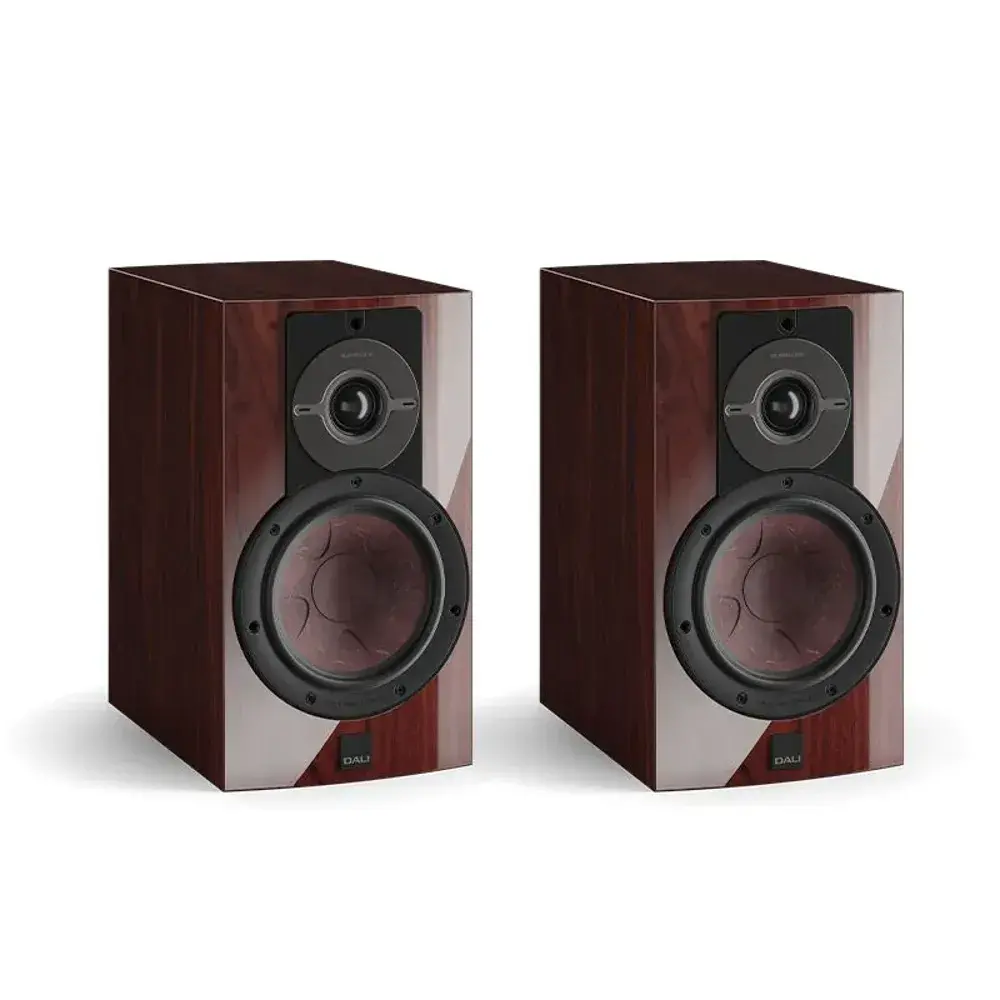
Short summary
A stand-mount speaker combining compact size with expansive sound, pairing a 29mm soft-dome tweeter with a 6.5-inch Clarity Cone driver. Bi-wire terminals support banana, spade and bare-wire connections, with SMC drivers, handcrafted in Denmark.
Key info
- Stand-mount speakers w/ expansive sound for their size
- 29mm soft dome tweeter
- 6.5 inch Clarity Cone driver
- Hybrid tweeter module w/ SMC drivers
- Continuous flare bass reflex ports
- Bi-wire terminals taking banana, spade or bare wire
- Four finishes available
- Handcrafted and tested in Denmark
Specifications
| Dimensions (HxWxD) | 350 x 195 x 335 mm |
| Frequency range | (+/- 3 dB) 50 - 26,000 Hz |
| Recommended Amplifier Power | 40 - 150 Watt |
| Sensitivity | (2.83V/1m) 87 dB |
| Impedance | 4 Ω |
| Crossover frequency | 2,800 Hz |
| Crossover type | 2-way |
Description
Compare The Range
Three of Dali’s compact standmounts across the range, side by side. Here is the Dali Rubikore 2 alongside the smaller Menuet SE and Opticon 2 MK2, showing what your money buys as you climb.
|
Opticon 2 Mk2
|
Menuet SE
|
Rubikore 2
This model
|
|
|---|---|---|---|
| Price | £999 | £1,499 | £2,599 |
| Frequency Responce | 59 – 25.000 Hz | 59 – 25,000 Hz | (+/- 3 dB) 50 – 26,000 Hz |
| Recomended Amplifier Power | 30-150 W | 20 – 100 W | 40 – 150 Watt |
| Sensitivity | 86,5 dB (2.83V/1m) | 86 db | (2.83V/1m) 87 dB |
| Impedance | 4 Ω | 4 Ω | 4 Ω |
| Dimensions (HxWxD) | 351 x 195 x 297 mm | 250 x 150 x 230 mm | 350 x 195 x 335 mm |
| Weight | 7.7 kg | 4.0 kg | – |
The long read.
The Rubikore 2 is the only standmount in Dali’s Rubikore range, and it exists to bring technology from the company’s flagship Kore loudspeaker down to a price real people can pay. The Kore was a cost-no-object design exercise; the Epikore 11 brought some of it within reach at still-serious money; and the Rubikore range democratises it further, with the Rubikore 2 the most affordable way in. It is a two-way of genuine high-end intent, hand-assembled in Denmark, and unusual in the range for what it leaves out: alone among the Rubikore models, it uses a conventional soft-dome tweeter rather than the hybrid dome-and-ribbon module.
Brief product overview
A two-way rear-ported standmount with a 29mm low-loss soft-dome tweeter and a 6.5-inch Clarity Cone paper and wood-fibre mid-bass driver using Dali’s patented SMC magnet technology, which reduces distortion and eddy currents in the double-magnet motor system. The cone carries a new stiffening pattern to improve break-up behaviour, and the continuous-flare rear port, borrowed from the Kore, keeps airflow quiet for cleaner bass tuned to 44Hz. The crossover uses premium Mundorf capacitors, though it does without the SMC-core inductors of the floorstanding models. Frequency response runs from 50Hz to 26kHz, sensitivity is 87dB with a 4-ohm nominal impedance, and Dali recommends amplification from 40 to 150 watts, with a maximum output of 107dB. Five-way bi-wire binding posts are fitted. It measures 350 x 195 x 335mm and weighs 9.5kg each, in four finishes, hand-assembled and tested in Denmark.
How it sounds
The Rubikore 2 is informative, dynamic and entertaining, with the intense clarity and expansive imaging that the Kore-derived engineering provides, and a generous, well-timed bass that is remarkable for a speaker of this size, reaching a genuine 50Hz. The Clarity Cone driver gives it a clean, natural midrange, and the soft-dome tweeter, while lacking the ribbon of its siblings, keeps the top end smooth and detailed. It is a speaker that reveals the quality of what feeds it and rewards good partnering. At 87dB into a 4-ohm load it is not a truly difficult speaker, but reviewers agree it is not one for a very low-powered amplifier either; it wants something with real current and control to give its best.
What we’d partner it with
The Naim Uniti Atom is a celebrated match for this speaker, a pairing of British and Danish engineering that dealers and reviewers return to often. It is a streaming integrated bringing Naim’s network platform, a DAC and 40 watts of the company’s characterful amplification into one compact chassis, with the current and drive to make the Rubikore 2 sing at sensible levels in a small or medium room. Streaming covers Spotify, Tidal, Qobuz, AirPlay 2, Chromecast and Roon, and recent versions add HDMI ARC for a television. Good alternatives from brands we carry, with more power for a larger room, are streaming integrateds and amplifiers from Bluesound and Rega.
For vinyl, note the Uniti Atom has a single line input but no phono stage, so a turntable needs one between the two. Naim makes the ideal solution: the StageLine, a compact phono stage that powers directly from the Atom’s DIN socket rather than needing its own supply. The Pro-Ject The Classic EVO is a fine partner, a decoupled sub-chassis deck with a carbon-aluminium tonearm and a moving-magnet cartridge fitted, connecting through the StageLine into the Atom’s line input.
For stands, the Solidsteel SS-5 is a well-made partner from Solidsteel’s vintage-styled Hi-Fi range that sets the speaker at the right height, and the Rubikore 2’s bi-wire terminals allow two cable runs if you wish.
Who shouldn’t buy it
If your room is large, the floorstanding Rubikore 6 and 8 add scale, deeper bass and the hybrid ribbon tweeter. If you specifically want that ribbon tweeter, note the Rubikore 2 is the one model in the range without it, using a conventional soft dome instead. And if your amplifier is very low-powered, this is not the speaker for it; the Rubikore 2 is a high-end standmount that wants a capable amplifier to justify the outlay.
One loudspeaker, two complete systems. Here’s how we’d build around it.
The Streaming System
A streaming integrated with a DAC and room correction, on matching stands.
The Analogue Extension
The same system with a flagship turntable added, straight into the amplifier’s phono stage.
Useful Notes
The Rubikore 2’s port fires from the rear, so leave space behind the cabinets; set them on the stands with the tweeters near ear level and a modest toe-in. Set the Uniti Atom up over the network through the Naim app, using Ethernet where you can. For vinyl, connect The Classic EVO to the StageLine, and the StageLine to the Atom’s line input and its DIN power socket, which powers it; match the StageLine variant to the turntable’s cartridge. The bi-wire terminals allow two cable runs if you wish; otherwise leave the links fitted.
User reviews


There are no reviews yet.
Leave a review