

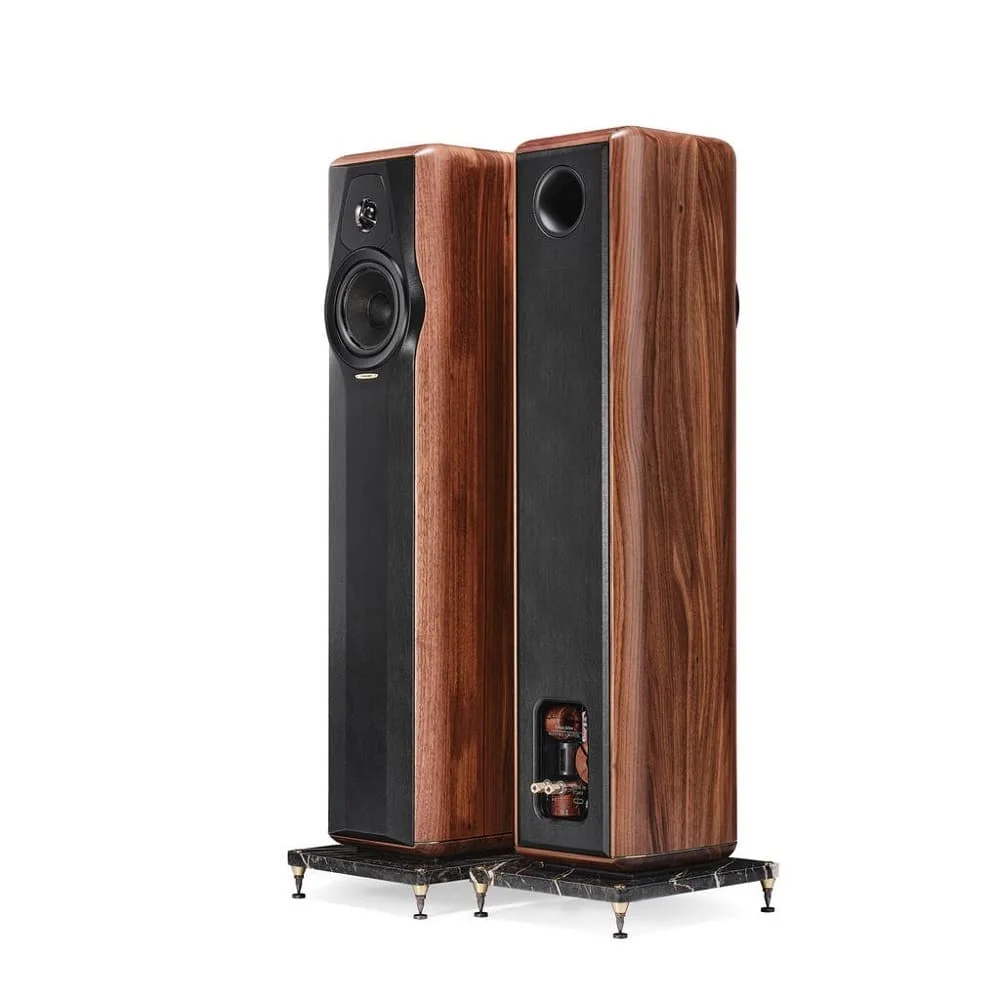
Short summary
The third member of Sonus Faber’s Heritage family, a two-way floorstanding speaker with a solid wood cabinet. It honours the brand’s Italian roots and artisans, blending heritage-inspired design with modern audio engineering and signature craftsmanship.
Key info
- Two-way floorstander w/ a solid wood cabinet
- Third member of the Heritage family
- Honours Sonus faber's Italian roots and artisans
- Realises a long-standing design ambition
- Craftsmanship and attention to detail throughout
- Heritage-inspired design w/ modern engineering
Specifications
| Weight | 38 kg |
| Dimensions (HxWxD) | 1120 x 300 x 350 mm |
| Active / Passive | Passive |
| Sensitivity | 88 dB SPL (2,83V/1 m) |
| Impedance | 4 ohm |
| Crossover frequency | 2,100 Hz |
| Power Handling | 25-125W |
| Frequency Response | 35 Hz – 35.000 Hz |
| Design type | 2-way floorstanding vented loudspeaker system |
| MF | 180 mm cone driver |
| HF | 28 mm “Arrow Point” DAD tweeter |
| What's in the box | 1 Manual | 1 Photobook | 1 Cleaning kit | 2 Magnetic masks | 2 Fabric dust covers | 2 Protective plastic covers | 8 Spikes and 8 dice | 8 Spikes bases / floor discs |
Description
Compare The Range
Sonus faber’s Heritage Collection, side by side. Here is the Maxima Amator, the only floorstander in the range, alongside the two standmounts, showing what your money buys at each step.
|
Concertino G4
|
Electa Amator Minima III
|
Maxima Amator
This model
|
|
|---|---|---|---|
| Price | £4,625 | £10,890 | £17,500 |
| Frequency Responce | 60 -25.000 Hz | 40 Hz – 35.000 Hz | 35 Hz – 35.000 Hz |
| Sensitivity | 85dB | 88 dB SPL (2,83V/1 m) | 88 dB SPL (2,83V/1 m) |
| Recommended Amplifier Power | – | 35 – 125 W | – |
| Impedance | 4 Ohm | 4 ohm | 4 ohm |
| Dimensions (HxWxD) | 314 x 214 x 297 mm (without stand) | 375 x 235 x 360 mm | 1120 x 300 x 350 mm |
| Weight | 6.6 kg | 14.6 kg | 38 kg |
The long read.
The Maxima Amator is the largest speaker in Sonus faber’s Heritage Collection and the answer to a problem the company had set aside as impossible: a floorstanding cabinet built from solid walnut. Solid wood moves and changes shape over time in a way MDF and plywood do not, which is why makers use it for small standmounts and rarely for tall cabinets. Sonus faber persisted, and the Maxima Amator is the result, a two-way floorstander in solid walnut on a marble plinth, with a brass line around the base and leather on both front and rear baffles. It is understated by the standards of luxury audio, which is a large part of its appeal.
Brief product overview
A two-way vented floorstanding loudspeaker using the H28 XTR-04 Damped Apex Dome 28mm silk tweeter, with a neodymium motor system and a rear chamber of solid spruce, the wood used in acoustic guitars, and a 180mm MW18XTR-04 mid-woofer with an air-dried cellulose pulp and natural fibre cone on a die-cast aluminium basket. Both drivers are shared with the Electa Amator III. What is not shared is the crossover, which is found in no other Sonus faber speaker: an Interactive Fusion Filtering design that connects the drivers in series rather than parallel, handing over at 2.1kHz, which the company argues integrates their outputs more completely. The design precludes bi-wiring, so each cabinet carries a single pair of binding posts. Frequency response runs from 35Hz to 35kHz, five hertz deeper than the standmount, sensitivity is 88dB and nominal impedance is 4 ohms, with 25 to 125 watts suggested. It stands 1,120mm tall and weighs 38kg each, in solid walnut with a marble plinth. Every pair ships with a measured graph showing how closely the two cabinets match. It is made in Vicenza.
How it sounds
The Maxima Amator gives an organic, open soundstage with the tonal beauty that defines Sonus faber, and the series-connected crossover does seem to pay off in how completely the two drivers merge; there is no obvious handover point, just a continuous presentation. The solid walnut cabinet and marble plinth give it a solidity that a two-way of this size would not otherwise have, and it reaches to 35Hz without a third driver. Measurement is reassuring on the amplifier front: unlike the Electa Amator III, whose equivalent load falls low enough to trouble some amplifiers, the Maxima’s impedance minima stay at or above 4 ohms across the band, making it a considerably more benign load. What it will not do is play as loudly or as hard as the Olympica range; this is a speaker for tonal beauty and craft rather than for slam.
What we’d partner it with
The McIntosh MA9500 is a natural centrepiece. Its Autoformer output delivers the full 300 watts into 2, 4 or 8 ohms alike, so the speaker’s impedance is irrelevant to it, and doubled power supply filter capacity over the MA9000 lifts dynamic headroom to 2.8dB. It carries the DA2 digital module with HDMI ARC, ten analogue inputs, and separate moving-magnet and moving-coil phono stages with adjustable loading, so almost any turntable connects directly.
One thing the MA9500 does not have is a network streamer. It is Roon Tested rather than Roon Ready, with no Wi-Fi, Bluetooth or AirPlay, so streaming requires a separate source. The HiFi Rose RS130 is an excellent one: a dedicated network transport with no converter of its own, sending a clean digital signal to the MA9500’s DA2 DAC, which is exactly the division of labour both components are designed for.
For vinyl, the Thorens TD 124 DD is a fitting partner for a speaker built on this much heritage, being a modern direct-drive reinterpretation of one of the most celebrated turntables ever made. Whichever cartridge it carries, the MA9500’s separate phono stages will accommodate it.
On cabling, use a well-made speaker cable of appropriate gauge for the run; the Maxima Amator takes a single pair, as its crossover does not permit bi-wiring. AudioQuest and Chord are the cable brands we stock.
Who shouldn’t buy it
If you want the same drivers and character in a standmount, the Electa Amator III uses both, though with a more demanding impedance. If you want a speaker that plays loud and hits hard, the Olympica range does that better; the Maxima Amator is built for tonal beauty rather than force. And note the suggested power range tops out at 125 watts, so while the MA9500’s 300 watts give useful headroom, this is not a speaker to drive hard for long periods.
One loudspeaker, two complete systems. Here’s how we’d build around it.
The Streaming System
A McIntosh integrated with Autoformer power and a DA2 DAC, fed by a dedicated network transport.
The Analogue Extension
The same system with a Thorens direct-drive turntable added, straight into the amplifier’s phono stage.
Useful Notes
The Maxima Amator weighs 38kg each, so positioning is a two-person job. Measurement suggests the treble lifts slightly above 5kHz on the reference axis, so toeing the speakers a little off-axis brings the midrange and treble into better balance at typical listening distances of around three metres. Connect each speaker to the Autoformer tap matching its nominal impedance, 4 ohms here, rather than to whichever posts are nearest. The RS130 connects to one of the MA9500’s digital inputs, as it is a transport without a converter of its own. For vinyl, use the moving-magnet or moving-coil input to match your cartridge, and set the loading accordingly. Each pair ships with its own pair-matching graph, which is worth keeping with the documentation.
Downloads
Owners-Manual_Maxima-Amator
Download PDFUser reviews


There are no reviews yet.
Leave a review